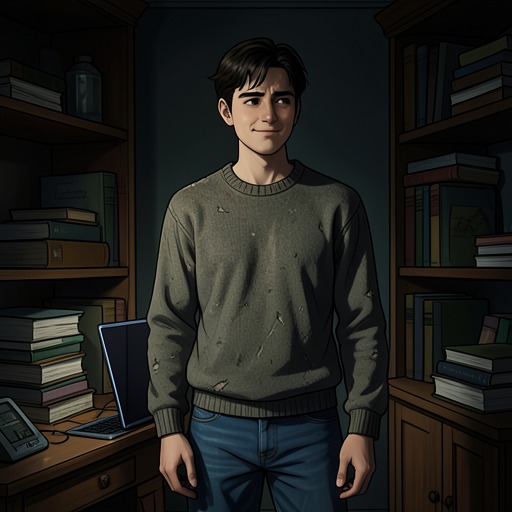
Dexter Mayhew’s television fame
One DayDexter Mayhew’s television fame gives him a public identity and a rapid professional ascent, but it is also a fragile asset whose eventual disappearance makes him feel diminished. Television first seems to offer a home for his talents without the toil he associates with becoming an exceptional photographer; recognition then feeds his confidence and becomes part of his performance. Later, professional failure and age turn that same recognition into an uncomfortable reminder of a vanished career.
From photography to television
On Primrose Hill, asleep in the evening sun beside a half-empty bottle of white wine, Dexter dreams about television. Photography has receded without much resistance: he believes he can remain a decent amateur, but doubts whether he wants the rejection and struggle required to become exceptional. Television, by contrast, appears to want him immediately. Though he once found watching it faintly unwholesome, he has become a passionate convert, treating the medium almost as a spiritual home.
That conversion takes place amid a changing television industry. Dexter sees television as immediate and influential, able to entertain and shape opinion in ways he believes books and plays cannot. Redlight Productions belongs to a new generation of privately owned independent companies, with bright open-plan offices, modern computer systems, and communal fridges. To Dexter, this is a lively alternative to the older, bureaucratic world of broadcasting—and a place where youth, confidence, and ambition carry value.
His own progress is swift. A woman he met on a train in India gives him his first job as a runner; he moves on to researcher and then assistant producer on UP4IT, a weekend magazine programme. He makes fast-cut films about grim housing estates, using fish-eye lenses and accelerated clouds set to acid house. The programme ranges across issues presented as relevant to young people, including drugs, dance music, sexually transmitted diseases, and police brutality. There is talk of putting him in front of the cameras, and his rise seems to offer a way to make his parents proud.
Recognition and the screen persona
The pleasure of the work extends beyond promotion. Dexter enjoys saying that he works in television, carrying videotapes to an edit suite on Berwick Street, and taking part in launch parties and the quick-moving routines of production. He likes the industry’s appearance-conscious youth culture and finds reassurance in a job that rewards energy, political sense, and self-confidence rather than requiring him to be as intellectually formidable as Emma Morley. Fame, initially, seems continuous with professional success: he has always wanted to succeed, and he sees little point in succeeding privately.
When a young couple recognizes him on Primrose Hill as the presenter of largin’ it, Dexter answers with an easy, showy manner. He has not consciously set out to become famous, but takes to presenting as though the camera had revealed a natural aptitude. The programme itself is undemanding: he introduces live bands, video exclusives, and celebrity interviews, often relying on swagger and the invitation to make noise. His confidence and charm help make the role look effortless.
The effort behind that ease is visible in his face. Dexter worries about appearing affected, cocky, or false, and privately works out an expression of studied nonchalance for moments when people recognize him. He replaces his sunglasses and returns to his book as though television were no great matter. Emma watches the performance and asks whether fame will change him. The scene makes recognition both a source of pleasure and something he already feels obliged to manage: his public ease is carefully arranged, while Emma can see the strain beneath it.
Fame as everyday access
By 15 July 1993, recognition has become an ordinary part of Dexter’s nights out. In a nightclub beneath railway arches, Tara approaches him after repeatedly offering massages to people on the dance floor. She recognizes him as famous and asks why. Over the music, Dexter explains that he is on largin’ it and interviews pop stars. Tara is delighted to place him, kisses his cheek, and distinguishes her own loveliness from his fame.
The encounter is brief, but it shows what his screen presence has made possible: a stranger can identify him and approach him without an introduction. His fame operates less as a measure of serious achievement than as a portable social fact, carried from the television programme into a nightclub at two in the morning. The gap between celebrity and intimacy remains apparent; Tara knows his public role, while the warmth of their exchange is improvised in the moment.
Exposure and professional decline
Public visibility also makes Dexter vulnerable to judgment. A newspaper headline asks whether he is the most odious man on television, turning his recognizability into a target for hostile appraisal. His live television debut with Suki provides a more immediate crisis. When she coughs and splutters on air, Dexter freezes, unable to speak or think while the seconds stretch. Suki salvages the broadcast with a professional joke, and Dexter recovers by joking that the bottle contains vodka before retreating to the autocue. His image as an assured presenter cannot protect him when the performance itself falters; in that moment, his colleague’s composure carries the show while his own failure is exposed to viewers.
The later decline of his television career reverses the promise of its early ascent. Mayhem TV plc, his independent company, becomes less a functioning business than an alibi for inactivity, and it is formally wound down at the end of the tax year to avoid accounting costs. Dexter has no experience as a producer, while the trainee editors and cameramen around the industry are in their mid-twenties. The youth-oriented world that once suited him has continued without making a secure place for him as he grows older.
Recognition after the career
At a later St Swithin’s Day, Dexter is supervising the delivery of rocket to a new Natural Stuff branch when the driver recognizes him as someone who used to be on television. The question marks a sharp change in tense and status: he is no longer encountered as a current presenter, but as a former one. He has entered the Natural Stuff business through Callum O'Neill and is learning its operations from the ground up, including cleaning juicers, making sandwiches in a hairnet, grinding coffee, and serving customers.
The work itself surprises Dexter by being acceptable, and it helps him provide for his family. What hurts is the look of pity he notices from customers, especially contemporaries who remember his minor fame. Some find him smaller in person than they expected. The recognition that once affirmed his success now measures the distance between his television visibility and his present circumstances. His fame has not simply vanished: it survives as an afterimage in other people’s expectations, while Dexter tries to inhabit a different working life.